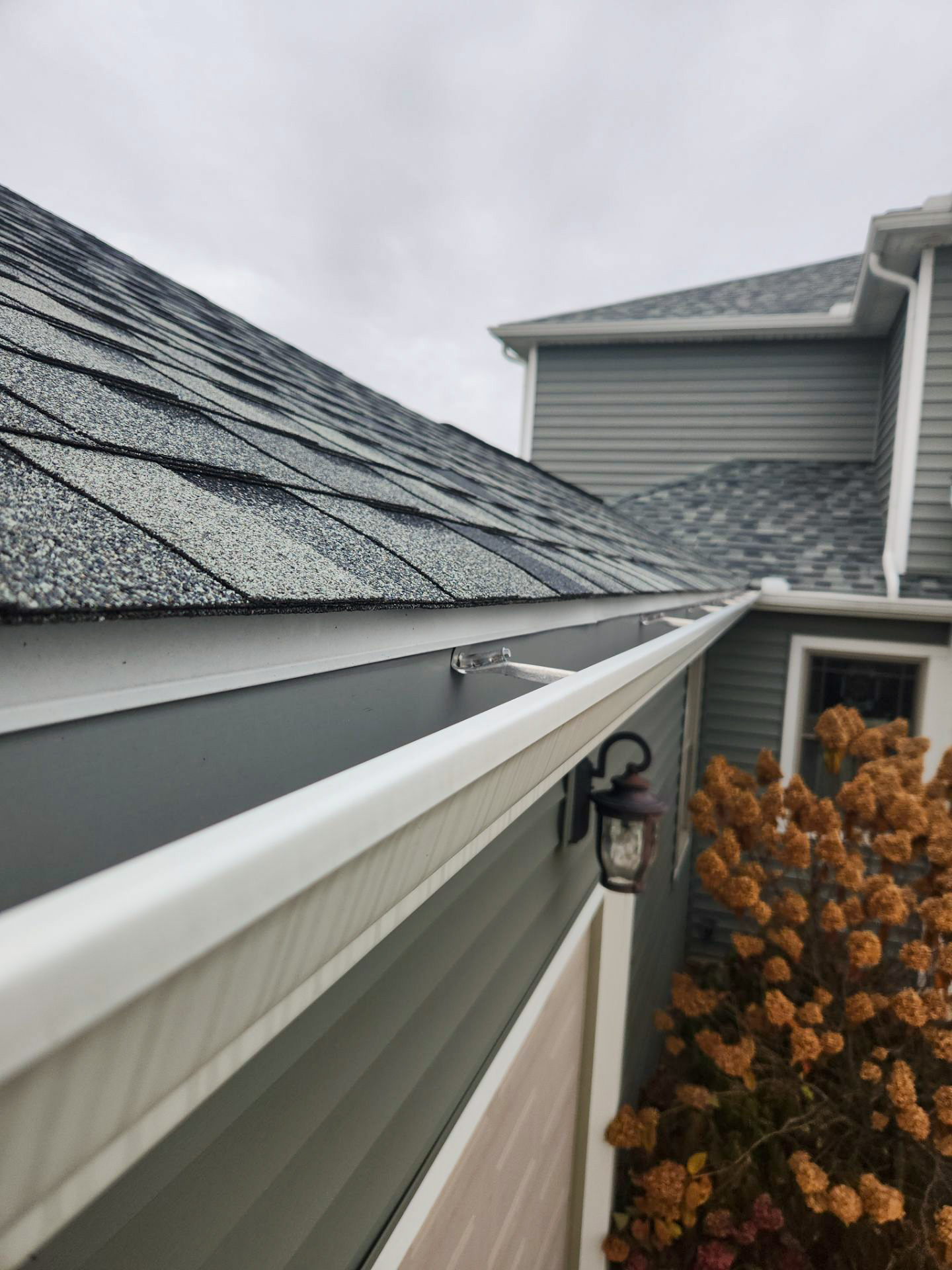
What are seamless gutters?
Seamless gutters have a flat back that sits flush against your fascia—that's the board running along the edge of your roof—and a decorative front that looks a bit like crown molding. The name comes from the side profile, which loosely resembles the letter K if you squint at it from the right angle.
They're the most common gutter profile on residential homes because they do two things really well: they carry a lot of water for their size, and they fit the look of most house styles without standing out awkwardly.
Why homeowners pick seamless gutters
- Handles more water per width than similar half-round profiles—the flat bottom and angled sides create more space inside
- Works with seamless fabrication to reduce joints and leak points along straight runs
- Mounts cleanly to fascia with hidden hangers, so you don't see brackets or hardware from the ground
- Pairs well with gutter guards—the wide opening at the top makes it easier to add covers that keep leaves and debris out
- Most homes in Canton, Ann Arbor, and Toledo use K-style gutters. The profile handles Midwest weather—heavy spring rains, fall leaf drop, winter ice—without looking dated or requiring constant adjustments. Over 25 years of installations across similar Ohio climates, and three years serving Michigan homeowners, we've seen K-style consistently outperform other residential profiles when it comes to capacity and clean lines.
- How Does Seamless K-Style Gutters Work?
Seamless gutters get made right at your house. We pull up with a machine that rolls flat metal into the K-style shape and cuts it to your exact lengths—no guessing, no pre-cut sections that might not fit quite right.
That means the long straight sections—the runs along your roofline—don't have joints in the middle. No joints means fewer places for water to drip through.
The only seams you'll have are at corners and where downspouts connect. Those spots get sealed properly during installation. The result is a cleaner look and way fewer drips compared to sectional gutters that snap together every ten feet.
Picture a 40-foot roofline. With sectional gutters, you'd have three or four joints along that run—each one a potential leak point. With seamless K-style, you get one continuous piece with sealed corners at each end. That's it.
The seamless approach also means the gutter sits tighter against your fascia. There's less chance of gaps forming over time because you're not dealing with multiple sections that can shift or separate.
Seamless vs half-round: what's
the difference?
Half-round gutters have a curved, semicircular shape—like cutting a tube in half lengthwise. They offer a classic look that fits historic homes or certain architectural styles where you want that traditional aesthetic.
But here's the trade-off: at the same width, half-round gutters typically hold less water than K-style. The curved bottom doesn't give you as much capacity as the flat-bottomed, angled-side design of K-style.
When to choose seamless gutters
- You want maximum water-handling capacity for the width
- Your home has modern or mixed architectural details
- You're looking for a profile that blends in rather than makes a statement
When to choose half-round
- You're restoring a historic home where authenticity matters
- You prefer the rounded look and you're willing to step up in size (like going from 5-inch to 6-inch) to get the capacity you need
- For most residential projects where function and clean lines matter more than period accuracy, K-style is the everyday pick. It does the job, looks clean, and doesn't make your neighbors wonder why you chose something unusual.
How do you know what size seamless gutter you need?
Most homes use either 5-inch or 6-inch K-style gutters. The right size depends on how much water your roof sheds during heavy rain.
Larger roofs and steeper pitches push more water into the gutters faster. If you have a big, steep roof, you'll probably need 6-inch gutters to handle the volume. Smaller or flatter roofs can usually get by with 5-inch. Here's how we figure it out: we measure your roof area, check the pitch (how steep it is), and look at where water naturally collects. Then we place downspouts in the spots where water flows heaviest. The goal is to move water off the roof and away from your foundation without overflowing the gutters or overwhelming the downspouts.
One thing to avoid: undersizing your gutters to save a little money upfront. If your gutters can't handle the flow during a heavy storm, water spills over the edge and defeats the whole purpose. It's better to go slightly larger if you're on the borderline.
Common mistake we see: Homes with 5-inch gutters that should have been 6-inch from the start. After 25 years of gutter work in similar conditions, the signs are easy to spot—water pooling near the foundation during spring storms, landscaping erosion below the roofline, or gutters that overflow before the downspouts can keep up.
We see this pattern consistently across Southeast Michigan and Northwest Ohio. Sizing it right the first time prevents all of that.
Gold Standard
Every Project Protected for Life
Every Integrity project includes free annual inspections and lifetime workmanship coverage to ensure your home stays protected year after year. No enrollment, no additional fees, just our promise of Gold Standard quality.
See What's IncludedWhat Homeowners Are Saying
READY TO REPLACE YOUR GUTTERS?
Schedule Your Free Inspection
We've completed gutter installations for over 10,000 customers across Canton, Ann Arbor, Toledo, and surrounding areas. Every installation is backed by our Lifetime Workmanship Warranty—if installation-related issues surface years later, we address them at no cost. Our Gold Standard Protection Plan ensures your project meets clear timelines, cleanup standards, and communication benchmarks from estimate through final walk-through. We've also earned the Better Business Bureau's Torch Award for Ethics, recognition that not every contractor can claim.